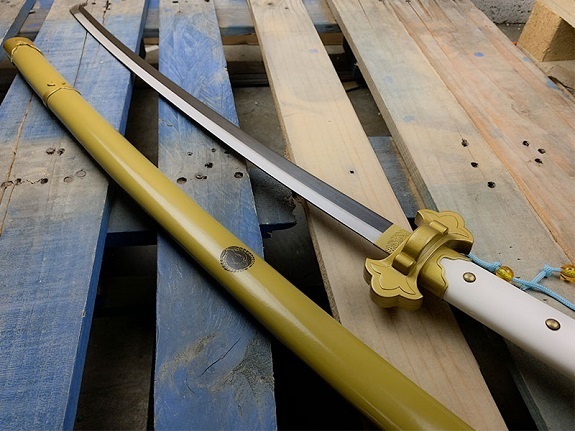
Throughout the history of feudal Japan many weapons were used by the samurai military class, such as a spear, war club, bow but the most prominent of all was the Katana sword-a samurai sword that has an immense importance in art and history of Japanese society.
Katana sword helped shape the face of warfare in Japan for over a thousand years. This samurai sword has become an iconic symbol not only for its role in samurai culture but also in the 21st century as the most famous and easily recognizable weapons on earth.
This fascination with the Katana sword has led to the rise in popularity of modern day katana sword replicas as many outside Japan have begun romanticizing them in ways never imagined before. Let’s dispel all misconceptions and myths surrounding the katana sword by tracing its origin and history through the ages.
The Pre-Katana Period
Let’s go back all the way to when Japanese swords weren’t even Japanese designs. Early Japanese armor swords-unlike Katana sword- were double-edged blade weapons that were found throughout China and Korean and were actually akin to the Jian- the Chinese sword.
For a time before the Katana sword came into being, the makers of these medieval swords were actually brought over to Japan or eventually Japanese craftsmen began to learn and emulate their designs yet while these swords indicated a form of fighting that relied more on thrusting and stabbing motions.
Typical Japanese sword style employed far more slashing and cutting motions and this is where roots of a Katana sword lie- as craftsmen began steadily introducing a curve to their blades
Tachi- Predecessor Of Katana Sword
The legend of the Katana sword has its roots in the 700 BCE, when a swordsmith in Yamato named Amakuni became disheartened upon seeing his very own blades broken after battles.
Wishing to improve on his craftsmanship and forge superior blades, amakuni set forth to forge a strong curved single-edged blade. He was perhaps the first to introduce the process of folding steel, to not only improve strength of the samurai swords but also to remove impurities.
This process gave rise to Tachi-which in many ways was a precursor to the Katana sword. Soon, the soldiers began returning from battle with their swords still intact and the swordsmith’s design quickly caught on and led to an invention of the most fearsome samurai sword in history- the Katana Sword.
The Oldest Katana Sword
By the 10th century, after a few hundred years of perfecting the design the samurai sword blade was improved by combining various steel that differentiated in hardness and carbon content. Craftsmen were able to produce Katana swords that had a strong cutting edge and a soft core body which not only lightened their weight but also provided cushioning for blows.
These swordsmiths had created what would become an incredible work of art by the late 1100s. The samurai took control of the country after the end of this year which caused sword production to flourish as the warrior class was now governing over Japan. Katana sword became ever more popular.
Katana sword was becoming a staple of the samurai class as the primary weapon used in battle. Japan suffered two invasions from Kublai Khan’s Mongol armies in 1274 and 1281 which drastically changed the face of warfare in Japan as the samurai style of fighting met challenges against mainland tactics.
The Changing Katana Design
Katana helped the samurai to adapt to fighting close-knit clusters of Mongol infantry. This type of group combat gave rise to a need for shorter and more agile blades than the longer tachi and katana swords had. This would lead to an increased demand for shorter swords not only for fighting the Mongols but also later for close quarters street fights.
The end of the Mongol invasions saw new methods to forge the katana sword. Masamune- the master swordsmith, emerged with a long wide bladed sword that was deadly on impact. This version of the katana sword had a durable and shorter blade which provided excellent mobility handling and weight while specifically not sacrificing too much of the reach that tachi had provided.
The blade length of the katana sword was made shorter upto 28″ inches, which was considerably shorter than the tachi. Besides the length factor, the katana sword had a less pronounced curve.
Katana sword’s short blade allowed for convenient unsheathing however outside of armored warfare, a katana was always to be warned blade up as without armor hampering one’s mobility the blade could be drawn up quickly in defense.
19th Century And The Decline Of Katana
While samurai culture became a hallmark of the East,a feudal society that had existed outside of Europe was coming to an end. The military classes started using shirt daggers and revered back to the spears for combat purposes. This was largely due to poor quality Katana swords being mass produced by factories during the later wars.
The katana did see a resurgence during the second world war, where the nobility of samurai and their beloved katana swords was used as a way to aggravate nationalistic feelings and partriotism in modern Japanese society.
However, when the US invaded Japan in 1945, it banned all the swords that had resurfaced, including the katana sword. This period saw the end of mass factory produced versions of the katana sword in Japan.
Modern Day Katana Sword
Kenjutsu-the art of Japanese sword fighting-has remained popular in Japan and would even draw in enthusiasts from across the world. Sword production of katana would also continue although due to increased demand in the West, this also gave rise to rather cheaply made katana swords that were not properly crafted.
Katana swords are still being made today using the lengthy smithing processes of the past but these swords are extremely expensive but the katana sword is the truest form of modern Japanese sword.
Japanese samurai swords-including the katana sword- may be shorter and weaker than the traditional European medieval swords, but their legacy is just as strong and remains so till this day.
Read Also: Best Airsoft Sniper Rifle- Review Of The MK51 Airsoft Sniper
 Outdoor Gear